PONGAMIA VEGETABLE OIL TO BIOFUELS
DROP-IN BIOFUELS ARE THE MOST EFFECTIVE RESPONSE TO ENERGY TRANSITION TARGETS, GLOBALLY.
We are investing time, effort, knowledge and money to be part of the Global Transition from carbon-based industries to biobased production.
AFFORDABLE AND RELIABLE FEEDSTOCK
As corporates are turning their backs on palm oil in energy applications for sustainability reasons and with the EU looking to gradually limit the imports of palm oil mill effluent (POME), the need for an amplified range of advanced feedstock streams is bigger than ever. This is in light of the EU’s accelerated transport sector decarbonisation trajectory with Renewable Energy Directive (RED II) through the 2030s.
Global demand for advanced feedstocks from sustainable sources is already outstripping the supply, with hydrotreated vegetable oil (HVO) demand expected to increase substantially over the next decade. There is a clear gap between current and HVO production capacity under construction and the availability of advanced waste-based feedstocks. As a reflection of this bottleneck, refiners in Europe are currently building three times more HVO production capacity than what can be supported by readily available feedstocks. In the US, a 10-fold overcapacity is estimated, meaning worldwide HVO refiners might face largescale short supply.
Reforestation and production of feedstock for biofuels, proteins and green fertilizers
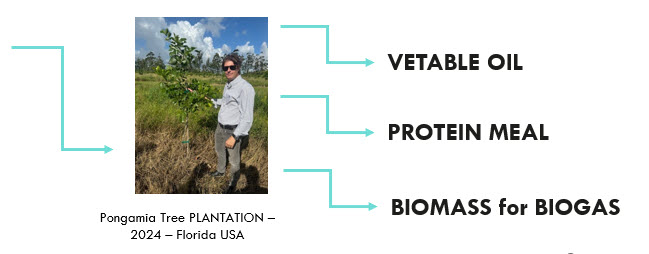
Pongamia is a highly sustainable, low carbon feedstock that can be grown on poor quality, underutilized land without causing indirect land use change concerns. Through expanded planting projects, we aim to significantly increase Pongamia feedstock availability in addition to the vast wild harvest supply available to help meet demand. With estimated yields up to 1.5-1.6 metric tons of oil per acre (3.7 MT per Ha) annually *, Pongamia can produce over twice as much oil per acre as other oilseed crops.
PONGAMIA OIL
The BEST raw material for the Biofuels process !
Crude Pongamia oil excels as a raw material for the production of advanced hydrotreated fuels, i.e., renewable diesel (RD) and sustainable aviation fuel (SAF).
In the process, we obtain the following:
- Sustainable Aviation Fuel (SAF)
- Renewable Diesel
- Gasoline fraction for further processing in the process of isomerization or olefin pyrolysis
Organic Natural Food:
Production of Non-GMO proteins as human food and animal feed, by using MARGINAL land converted to agriculture, not competing on premium land or water resources is an added value to biofuels production and supply chain .
PONGAMIA
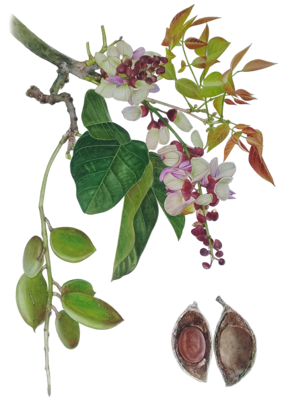
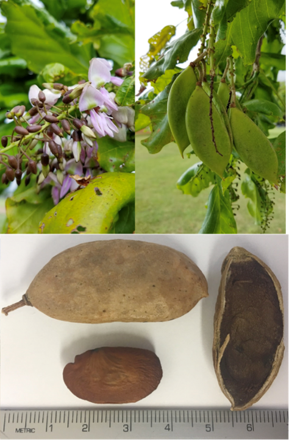
Pongamia pinnata (L.) Pierre (Pongamia) is a tree native to Southeast Asia. Recently, interest in Pongamia focused on its potential as a biofuel source as its seeds contain around 40% oil.
However, Pongamia has multiple applications beyond biofuel production. It is a legume, can form symbiotic associations with mycorrhizal fungi, has been shown to be tolerant to drought, salinity, and heavy metals in soil, and has potential to mitigate climate change.
Additionally, Pongamia oil has medicinal properties, can be used as biopesticide, insect repellent, to produce soap, and as a source of edible grade vegetable oil.
The seed cake can be used as a source of bioenergy, food and feed protein, and organic fertiliser, and the flowers are a good source of pollen and nectar.
Pongamia can also bring socio-economic benefits as its ability to restore degraded and contaminated land provides opportunities for local communities through novel valorisation pathways.
Active compounds have disagreeable aroma and bitter taste that prevents insects from feeding on leaves or beans.
These multiple applications have potential to form part of a circular bioeconomy in line with sustainable development goals.
UNDERSTANDING PONGAMIA PINNATA BUSINESS MODEL
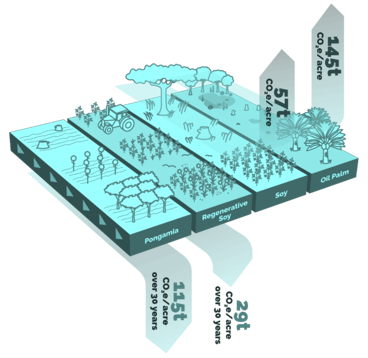
Global food production contributes a quarter of all greenhouse gas (GHG) emissions. As human population growth continues and overall wealth increases, our reliance on climate-disruptive livestock, soybean, and palm oil is poised to increase significantly. Even if we can squeeze marginal gains out of existing farmland, adopt best agriculture practices, and shift diets to less carbon-intensive alternatives, conventional agriculture risks adding substantial greenhouse gases through its inputs, cultivation, harvest, and transport. Our regenerative agriculture practices flip this dynamic.
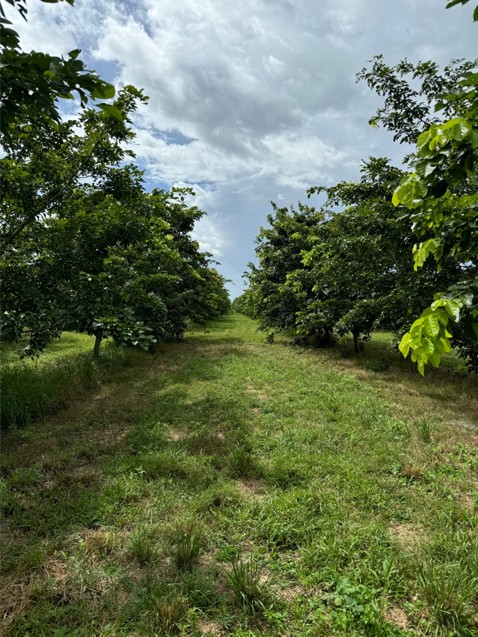
Pongamia trees are a permanent crop that can maximize and restore the productivity of degraded agricultural lands.
Pongamia’s natural adaptations to a harsh, monsoonal climate –pest resistance, drought and salt tolerance, and nitrogen fixation – reduce the need for inputs like pesticides and fertilizers that can negatively impact water quality and biodiversity.
Pongamia, a leguminous plant distributed in Southeast Asia and Oceania, is a highly efficient non-edible oilseed tree crop that does not compete with food crops. The oil extracted from Pongamia oilseeds through pressing is expected to be usable as a feedstock for SAF production using HEFA technology. However, because Pongamia has historically not been domesticated as a crop, the know-how for producing and cultivating superior Pongamia varieties is key to achieving consistent high yields of crude oil. From an initial set of Pongamia tree genetics selected over 15 years ago from Australia, Terviva has spent the last 15 years conducting extensive research on thousands of planted acres to narrow down to the very best performing genetics, with optimal nursery propagationand farming methods, to maximize Pongamia yields across different soil and environmental conditions.
HEFA(Hydroprocessed Esters and Fatty Acids)
Technology and process for producing SAF from hydroprocessed esters and fatty acids obtained by hydrotreating of vegetable oils and other materials. Certified as “ASTM D7566 Annex 2,” the international standard for SAF.
PONGAMIA MATURE ORCHARDS
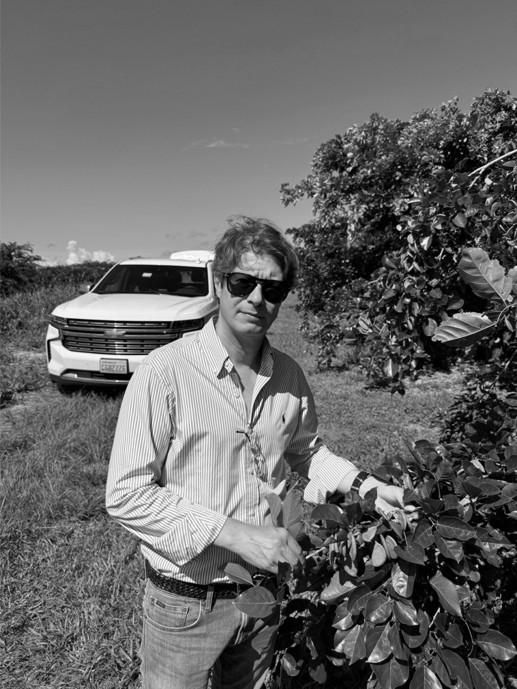
This full scale orchard based in West Palm Beach ( Florida – USA) is available for any detailed assessment or due diligence to be performed.
Millettia pinnata, also called karanja or pongamia, is indigenous to the Indian subcontinent and Southeast Asia; it is a monotypic genus with a single known species. As a nitrogen-fixing and self-pollinating tree, pongamia can be cultivated easily, even in non-fertile lands and waste lands.
Pongamia is a second-generation biofuel producer that does not compete directly with food production.
It will grow on soils not suited for broadacre crops and will tolerate salinity and flooding. More importantly, Pongamia is a legume that supplies its own nitrogen, has low costs and high energy efficiency.
It is a semi-deciduous, nitrogen-fixing tree that grows to a height of 15–20 m with a broad canopy and is known for its drought and salinity tolerance. The dense network of pongamia lateral roots aids in soil erosion control via binding sand dunes.
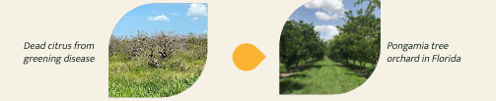
This type of tree has been already implemented in Florida (USA) to replace the 1,200,000 dead citrus trees and is currently under expansion by local farmers investment program.
The agricultural intellectual property (IP) spans high yielding pongamia cultivars and expertise in tree production, orchard management, crop yield improvement, and harvesting.
OUR PARTNER PRODUCES AND PLANTS PONGAMIA TREES THAT ARE CLONAL REPLICAS OF ITS PROPRIETARY ELITE CULTIVARS.