
OLEOCANTHAL
Extra-virgin olive oil (EVOO), a principal component of the Mediterranean diet (Med diet), is one of the most ancient known foods and has long been associated with health benefits. Many phenolic compounds extracted from Olea europea L. have attracted attention since their discovery. Among these phenolic constituents, oleocanthal has recently emerged as a potential therapeutic molecule for different diseases, showing relevant pharmacological properties in various pathogenic processes, including inflammation, cancers and neurodegenerative diseases. Here, we discuss and summarize the most recent pharmacological evidence for the medical relevance of oleocanthal, focusing our attention on its anti-inflammatory and chemotherapeutic roles.
Chronic inflammation is a crucial factor in these pathologies and the attenuation of proinflammatory mediators has been partially attributed to the high intake of EVOO accompanying the Med diet. Phenolic compounds extracted from EVOO have been shown to have antioxidant [2], anti-inflammatory [3] and antithrombotic activities [4]. In addition, olive oil has been suggested to alleviate cognitive decline resulting from neurodegeneration [e.g. Alzheimer’s disease (AD)] [5]. Many of these phenolic compounds, such as ligstroside and oleuropein, are responsible for the bitterness, pungency, and astringency of EVOO [6].
Recently, the European Food Safety Authority suggested an increase in the consumption of EVOO polyphenols because these compounds are able to prevent low-density lipoprotein (LDL) oxidation [7]. Thus, the increase in consumption of EVOO phenols, without increasing the total lipid intake, would be beneficial to the general population and, therefore, should be recommended by health authorities. However, phenol-rich EVOOs are bitter and pungent and, thus, might not be well accepted by those consumers who prefer sweet oils (such as refined olive oil or seed oils).
Anti-inflammatory activity of OLEOCANTHAL (OC) .
The first evidence for the anti-inflammatory effect of OC was published by Beauchamp and colleagues.
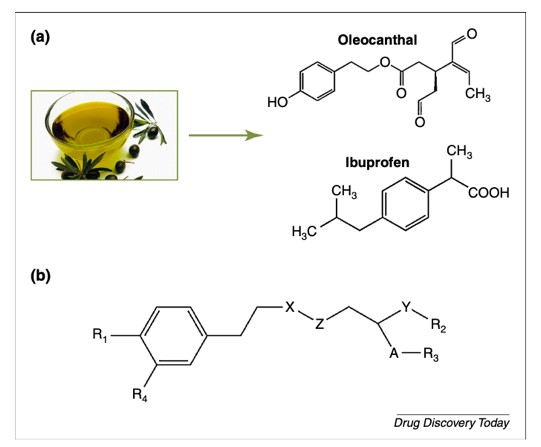
They reported that, similar to ibuprofen, which is a potent modulator of inflammation, and an analgesic, OC was able to induce dose-dependent inhibition of COX-1 and COX-2, which are involved in the biochemical inflammation pathways supported by arachidonic acid derivatives [9] (Fig. 2a).
Other groups have investigated the effects of OC and its derivatives on lipopolysaccharide (LPS) induced NO production in chondrocytes. NO is a gaseous mediator of the inflammatory response that is involved in multiple inflammatory degenerative diseases [19].
It was shown that OC, as well as its derivative 231, downregulated nitrite production and inducible (i)NOS protein expression in LPS- challenged chondrocytes [12].
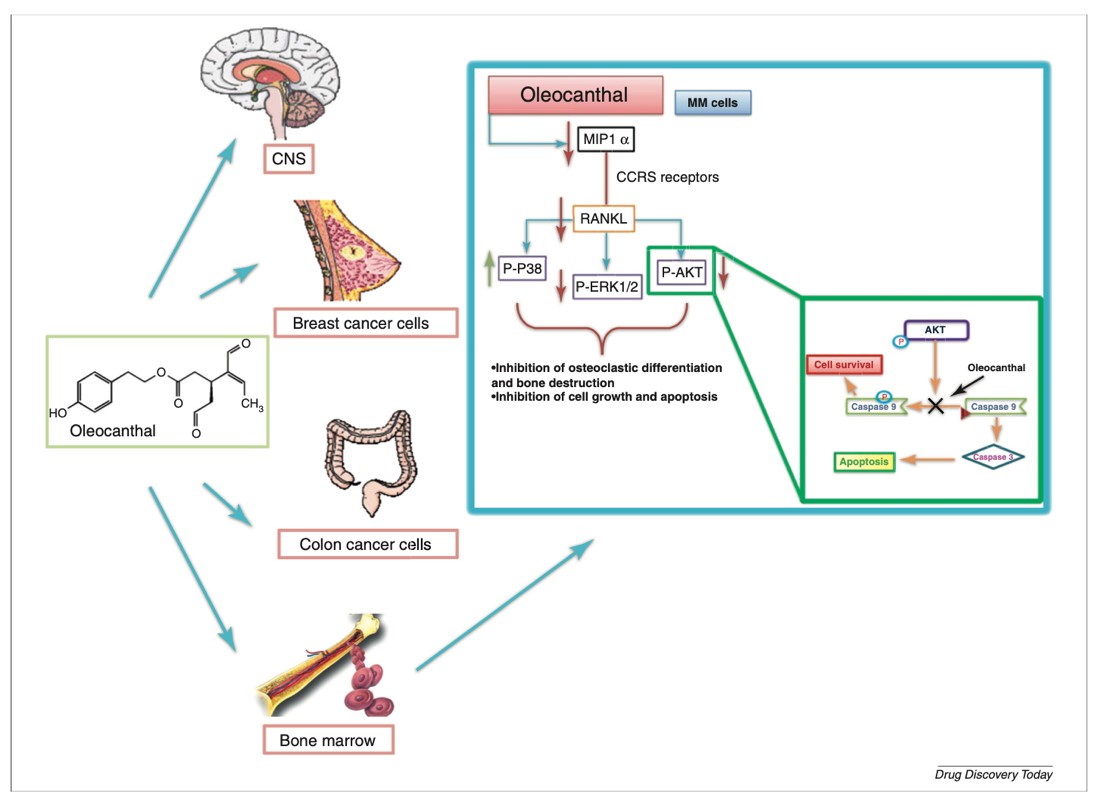
More recently, it was also demonstrated that OC was able to inhibit the inflammatory mediators, IL-6 and MIP-1a in murine chondrocytes and in macrophages challenged with LPS.
In addition, researchers showed that the anti-inflammatory actions of OC in macrophages were related to the inhibition of NO production, via iNOS downregulation, and also to a decrease of relevant pro-inflammatory cytokines, such as IL-1b and tumor necrosis factor (TNF) a [13] (Fig. 2b).
These inflammatory mediators have considerable roles in inflammatory degenerative joint diseases, such as osteoarthritis and rheumatoid arthritis.
Thus, on the one hand, OC inhibits local inflammatory activation in cartilage and, the other hand, it inhibits the inflammatory cascade in synovial cells. Taken together, these data suggest that OC could be an interesting therapeutic agent for the treatment of degenerative joint diseases.
Fig.2
Source: New drugs from ancient natural foods. Oleocanthal, the natural occurring spicy compound of olive oil: a brief history//Morena Scotece1, Javier Conde1, Vanessa Abella1,2, Veronica Lopez1, Jesu ́s Pino3, Francisca Lago4, Amos B. Smith III5,6, Juan J. Go ́mez-Reino7,8 and Oreste Gualillo1 – published by ELSEVIER Drug Discovery Today Volume 00, Number 00 November 2014